Wednesday, 19 September 2012

The 'New Toryism' of Cameroon Conservatism


I last blogged about the end of GCSEs two days ago, and since then my anger and resentment towards this facile 'revolution' has only grown. You won't find all that many emotions in this blog, but you will today.

You know what I think? I think this is a new departure - and a return for the Conservative Party to some of its older beliefs. Mrs Thatcher (above) was a radical - a Gladstonian Liberal who believed that, if you removed the checks on aspiration and achievement, many more people would achieve spectacular results. She wrenched the Conservative Party out of its torpor - and out of the deeply sceptical and anti-Enlightenment that all change regrettable and probably for the worse (though perhaps unavoidable in the end). She said: let people buy their council houses. Reduce their taxes. Her government abolished O-Levels and CSEs, and let all children be assessed on a single marginal gradient (from 11 As to one E). It also began the moves that bullldozed the Berlin wall between universities and polytechnics. Overall, it was a vision of modernity - of 'progress'. It went wrong continuously, and her confident Victorian view of markets was clearly misguided. I oppposed a great deal of her macro-economic policy at the time. And I still do. But there was some positivity about how the workaday populace were perceived.

The philosophy of the Education Secretary's new EBC, to be taken by all English children around the age of 16? It's got nothing to do with educational evidence, pedagogical concepts, or indeed with schools' actual views at all. There is in fact a mountain of evidence that continuous assessment is highly valued by both students and teachers - and raises attainment. That will be harder when schools (under exam leage table pressure) just look at a single exam, two years away. The evidence for the positive effects of modularity is more mixed (opens as PDF), but does at least suggest that more feedback, better planning and more flexibilty are valued by teachers and students alike.

That's why the most worrying suggestion among all Mr Gove's plans is so-called 'normative assessment' - the idea that only a certain proportion of children can ever attain a grade one, a grade two, and so on. The key consultation document is a bit vague on this (opens as PDF), but the Secretary of State's talk of many fewer students gaining the really top grade must involve some element of achievement relative to other students, rather than a set of skills or knowledge. Otherwise he would simply not be able to make such promises. All this, despite the evidence about how much more able children are at (for instance) processing information these days. Despite the constant rise in IQ levels across the developed world. Despite the march of information technology and new research techniques. No, says Mr Gove, flanked by his new ally Mr Clegg: we have to sort the sheep from the goats. We have to say: there are about twenty to thirty five per cent of the population (or whatever) who are 'academic', and then there are those that are not. Nothing can get better. The world cannot get smarter (it has, by the way). Societies can only be managed, not transformed.

It is a fundamentally depressing return to a Toryism that the neo-liberalism of the 1980s and 1990s looked as if it had buried - one of the benefits of Schumpeterian 'creative destruction', for all its massive and unnecessary casualty list.

Tuesday, 18 September 2012

Overfishing is a real and present danger


It's easy to get complacent about fish stocks. The fish are all sitting there in the supermarket, aren't they? They aren't going up in price all that rapidly (though they are going up); you can buy everything you always could; the streets are all full of fish and chip shops that still offer cod.

This type of beheaviour is almost unbelievable, given that latest academic figures on cod stocks in the North Sea. They're almost gone - and although this means that their prey species will have a better time for a while (think scampi and chips, instead of cod and chips), that won't always be the case. For the effects are unpredictable. New and worse predators can move in. Marine deserts can emerge. The food chain can break up, rather than bulge with things we like to scoop up and munch on.

The latest news from the European fisheries reform process is not encouraging. Although particularly disgusting and disgraceful practices such as throwing perfectly good fish overboard are a thing of the past (or they are supposed to be), and smaller boats might get a larger share of the catch in the future, Ministers are backsliding like they always do. They know, in their hearts, that Northern Europeans at least have learnt little from history - and the Canadian Grand Banks disaster of the early 1990s, which saw one of the richest fisheries in the world utterly obliterated. The Grand Banks have never recovered by the way. But they're weak. Give us a little bit more time, they plead. Don't make us unpopular, they whine.The advantage they have is that most Europeans no longer have living, visceral links with the sea, and they can't see the pathetic catches that are now (in some places) less than a quarter of what they were in the early 1970s.

It is even reported that the British have been involved in some particularly discreditable negotiations behind the scenes to get back control of 'their' stocks in return for watering down absolutely essential catch targets that will get us back to sustainable levels of wild fishing.

But what is the alternative? Well, it's this: the complete destruction of wild fisheries in Northern Europe first, and then across the whole of Europe after that. After which Europeans will probably move on to destroy North African and West African fisheries, but that's another story.

My advice? Write to your MP or MEP. In the meantime, don't eat any North Sea cod. Or any cod, to come to think of it.

Monday, 17 September 2012

'New' GCSEs: an over-reaction?


Today's announcement of 'tougher' and 'harder' GCSEs is an almost completely disingenuous blast of mendacity.

The main elements are, firstly, replacing continuous assessment with end-of-course testing. And getting rid of almost all coursework, so that exams are the main way of measuring attainment.

Talk about throwing the baby out with the bathwater.

Coursework, of course, has all sorts of problems. There is outright cheating around the edges of the system. More profoundly, teacher support and guidance can involve writing and re-writing continuous assessments, again and again and again. How many grey, enervating days have been spent re-working something that was a bit of a mess when it first turned up?

Neither is continuous assessment any sort of panacea. There is no doubt that some GCSEs (for instance in my own subject, History) have become too modular, too 'spotty' and too disaggreated from one another. So one moved from the Tudors to the Nazis via some history of science and medicine, without seeing much of the years in between.

But coursework was also innovative: a thoughtful reaction to a changing world. That's why it was brought in in (during the 1980s and 1990s) in the first place.And continuous assessment has definitely helped to lift attainment among groups that may not have the confidence or the traditions that help them attack the once-and-for-all highwire acts that exams represent.

Most worrying of all is the way in which these changes have been decided on and announced, in a stitch-up between the Coalition parties after the Liberal Democrats (quite rightly) objected to the absurd and anachronistic idea that there should be a two-tier exam system much like the old CSEs and O-Levels. Consultation? Public debate? Expert input? No thank you very much, says the Education Secretary, Michael Gove (above) - we'll just do what we want. The exact balance between final tests and ongoing benchmarks is a matter of legitimate controversy. The amount of coursework in each course (20 per cent? 40 per cent? 50 per cent?) must and should be re-assessed all the time.

But getting rid of both, in their entirety, reversing at a stroke thirty years of thought and practice? After years of making universities (for instance) bring in continuous assessment to match the school system? Overturning the expectations and the taught skills of young people coming up to that key age (and their parents)? I'm sorry, but this is just playing to the gallery.

And then there is the need to look at more fundamental questions. What is education actually for? Maybe we should have some form of testing at 14 and 18, now that staying on to that later date is going to become compulsory, rather than the increasingly-meaningless waymaker of 16? Shouldn't we address the concept of what knowledge and learning really are - rather than focusing on testing and examinations that reflect how much effort and practice parents and teachers put into the increasingly-desperate drive for educational attainment and differentiations? What should actually be in all these new exams?

All the rest is a sideshow. Sorry, but there you are.

Friday, 14 September 2012

England's universities: how not to make policy


It's difficult to know where to start when one considers the knots Vince Cable and David Willetts (above) have tied themselves in over English Higher Education policy.

Let's start with the most pressing issue in most people's minds: the new and higher fees structure. Regular readers will remember that clever-clever BIS officials and politicians had two cunning plans to hold down costs: their so-called 'core and margin' scheme, under they would auction off cheap places to HE and FE Colleges, and their 'AAB' idea, which meant that 'top' universities could take as many students as they like. This might encourage (Ministers said behind their hands) everyone else to cut their costs and prices to compete.

How's that all going, then? Er, well, as we said all along - it isn't. It's a farce.

Ministers have already abandoned the complex and unworkable 'core and margin' idea. Now they're discovering that their 'AAB' concept, which basically tore the cap off previously-regulated Russell Group numbers inside the more prestigious universities, isn't working either. Instead of rushing to those universities (which often seem the most desirable inside Ministers' 1950s imaginations), the chaos caused has meant that a lot of our most prestigious research universities have lost numbers across the board. Confused? Well, consider this: if you didn't make your AAB offer, and you fell to ABB, these institutions would probably drop you, as you counted under their cap and they might indeed get fined for letting you in. Rather than go into clearing, or try to pick up an AAB student from somewhere else (for which they often don't have the administrative capacity), they would then probably have to leave that place empty.

What a mess. The opposite of what was intended on every level.

And that's without looking at non-EU student visa targets and rules that change all the time. What did we say here, at Public Policy and the Past? That those numbers should be taken out of the overall, absurd and totally unreachable target of less than 100,000 in net UK migration every year. Now Ministers are scrambling to start just that process. Nice work, guys.

What else could we look at? Their failure even to bring in a Higher Education Bill, leaving the whole sector splatchcocked together and adrift? The Government's failure even to come out with a strategy for graduate study? Take your pick.

What's happening here is that policy-makers are inching out ever further into quicksands that they have never even tried to map, let alone fully understand. Charge more fees, they thought - but then, 'oh, that'll cost a lot'. Try to constrain costs by messing with admissions, they thought - only to abandon a more sensible post-A Level route that would allow universities and students to get all their ducks in a line, and avoid the AAB system's absurd results. Then they found that A-Level grades were sagging, perhaps due to reforms over at Education - something else they hadn't considered, and which has also helped to wreck the whole idea of taking the cap off 'elite' places.

Joined-up government? Any government at all would be a start.

Thursday, 13 September 2012

Warning: deregulation can be bad for your (political) health


The news that the Coalition Government is 'lightening the load of regulation', or 'tearing up the rules' on that dreaded bugbear, health and safety, should send a shiver down every spine.

It's often called an attempt to 'kick-start growth', which is strange, because the Business Secretary himself (responsible for deregulation) absolutely rightly points out that our present crisis has absolutely nothing whatsoever to do with too much government, and everything to do with the great big black hole that sits where consumer demand should be.

It's even more odd because the risk of political catastrophe are very high when you're meddling with this sort of thing. But an eerie silence hangs over the whole political battlefield, rather like Conservative and Liberal Democrats' head-in-the-sand attitude to the swingeing cuts to (for instance) disability benefits that are about to hit every MP's caseload and consciousness like a rocket.

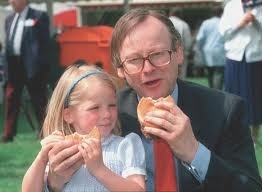
Remember BSE, the 'mad cow disease' whose true impact and extent among humans we still await with some trepidation? The whole scare did enormous political damage to the Major administration in the 1990s, indelibly seared on the public consciousness when the Minister responsible was shown feeding his daugher a burger in an apparent attempt to still public worries about the disease (above). Some of it was self-inflicted via a bizarre and self-defeating 'empty chair' protest at European Union level, but more of the public anger was directed against an official culture that erred on the wrong side of public safety, and leant over towards the farming industry just about as far as it could. Until shoving offal into the food supply turned out to be a really, really bad idea. Former Prime Ministers had to run for cover. The Opposition of the time had a field day.

All this because Ministers wanted to pose as fearless opponents of a nebulous and mythical 'health and safety culture' - whatever that is, when 20,000 people die every year from an injury or disease caused by their work. In the 1980s, that meant cutting corners on what was in meat pies. Now, it means stopping health and safety inspections of (for instance) nightclubs - places that are often packed, incendiary and dangerous, as any number of nightclub disasters demonstrate.

One day public and commentariat will note that there are historical reasons why we have regulations in the first place - rooted in past disasters, the lessons of yesterday, and the risks that we used to take and began to think were unacceptable.

In the meantime, I'd watch out and be a bit more careful if I were you. I wouldn't visit many subterranean wine bars, and if you go to any clubs, do have a look round at the fire exits, won't you?

Monday, 10 September 2012

Good news and bad news for American liberals


There's good news and bad news this week for Americans who lean over to the political Left - however mildly.

First off, the good news: President Obama is likely to be re-elected. The much-respected statistician and blogger Nate Silver now rates this (as of today) as very likely: likely just under 81 per cent of the time, in fact. That's quite a likelihood, and it's had some commentators saying that the Presidential election is all over - not that they think it ever really got started.

So lots of things that American centrists and leftists hold dear - healthcare reform, the relatively Keynesian spending plans that have been emanating from the White House, a woman's right to choose on abortion, immigation reform - won't die. They'll stay alive, at least as far as Presidential edict and order can secure.

The bad news? Well, it's that Americans are more divided and more partisan than ever. That's implicit, really, in the numbers themselves. The economy is, basically, crummy (though Europeans would love to see growth at an 'anaemic' two per cent a year). If a bare majority of Americans weren't entrenched in their positions vis-a-vis the issues listed above, and if they just said 'it's a referendum on the incumbent - let's kick him out', President Obama wouldn't have a prayer.

The Republican Party has moved so far to the Right that they seem to have gifted the President re-election. But that doesn't mean that his agenda will remain intact. In fact, it hangs by a thread. A thread called the Senate. We're probably going to see the upper chamber of Congress split 50:50, or 49:51 in one direction or the other - indication enough of how divided Americans have become. If that hair's breadth of a margin goes against the Democcrats, you can forget about anything being done in Washington for the next two years.

The state-by-state electoral map itself looks set fair to stay preserved in aspect. Mitt Romney might be able to take Indiana and North Carolina off Obama (hardly Democratic states in the first place). And that's it. Big deal. The President's party has been able to dig in, on cultural and moral issues, in a mirror image of the 2004 race - using 'wedge' politics to push Governor Romney off the centre ground (not that his party needs much help). It's all a far cry from their 50-state strategy of 2008 (see the map above), when Obama made some effort to campaign in and fight for every vote in every state. And it's a long way from the healthy cold wind of proper proportional representation and a real all-American electoral battle, which would be secured by the campaign for states to apportion their Electoral College votes in line with the popular vote. A more competitive picture might emerge one day, but not for a long time. At the moment, there's no point campaigning anywhere but the nine swing states in play - something that cements both parties into their trenches.

A doleful prospect - though not as bad as that facing Europeans tied up in knots by the Euro. But more on that anon.

Tuesday, 4 September 2012

Cabinet reshuffles: Prime Ministers, beware!


All Prime Ministers think that a Cabinet reshuffle can give them a short-term boost. It shows that the ultimate weapon, of hiring and firing Ministers, remains in their own hands; it can help with party management, by brining in the loyal and booting out the disloyal. And it can recapture initiative and momentum.

Well, in theory.

The history of these things actually shows many more examples of the nasty and the miserable among reshuffles - and some that have actually been lethal to Prime Ministerial authority.

David Cameron's ongoing reshuffle today is a bit of a shimmy to the Right (his hard-line backbenchers are unhappy), and a bit of flag-waving for his restless 2010 intake of MPs. Getting ride of Kenneth Clarke from Justice is a retrograde step for the old-timer, and for prisons and justice in general, but there you are. His relatively liberal views about crime and punishment are out of favour these days - more's the pity. Bringing in newer MPs might help make the Government seem less rackety and less confused - though the central planks of economic policy put in place by a very unpopular Chancellor will remain.

But in general, these sorts of operations don't help. They make a few headlines for a few days, and then the effect fades. Prime Ministers can be squeamish about sacking people, and Harold Wilson, Margaret Thatcher and Tony Blair all shrank from the task on more than one occasion. Blair wanted to move Gordon Brown in 2001, but just felt that he wasn't powerful enough to do so in the end. Sacking Norman Lamont as Chancellor severely wounded John Major when an angry ex-colleague clobbered him from the backbenches.

The worst example of all was Harold Macmillan (above), another Old Etonian Prime Minister who posed as somewhat more relaxed than he actually was. In 1961 he butchered nearly half of the Cabinet in a desperate attempt to salvage his own political position - and failed utterly, by giving off the whiff of hysterical over-reaction. He was gone within a year of so.

Something else about reshuffles, by the way: they always go wrong. This one has already, because Iain Duncan Smith was supposed to move from Work and Pensions to Justice - but refused.

The simple truth is that this government has lost direction much more quickly than any other of recent times. Compared to (for instance) the 1997-2001 Parliament, key figures such as Steve Hilton and Andy Coulson are gone, and with them a great deal of the creative tension and strategic nous that the Cameron operation wielded in Opposition. None of this rearranging of the deckchairs can change that, and history shows that it might even make things worse. The Prime Minister is now going to have to face a backlash from the sacked, the demoted and the passed-over without such those helpers. It might not be pretty.